Showing posts with label dropout rates in Georgia. Show all posts

Thursday, July 21, 2011

New report explores the school to prison pipeline

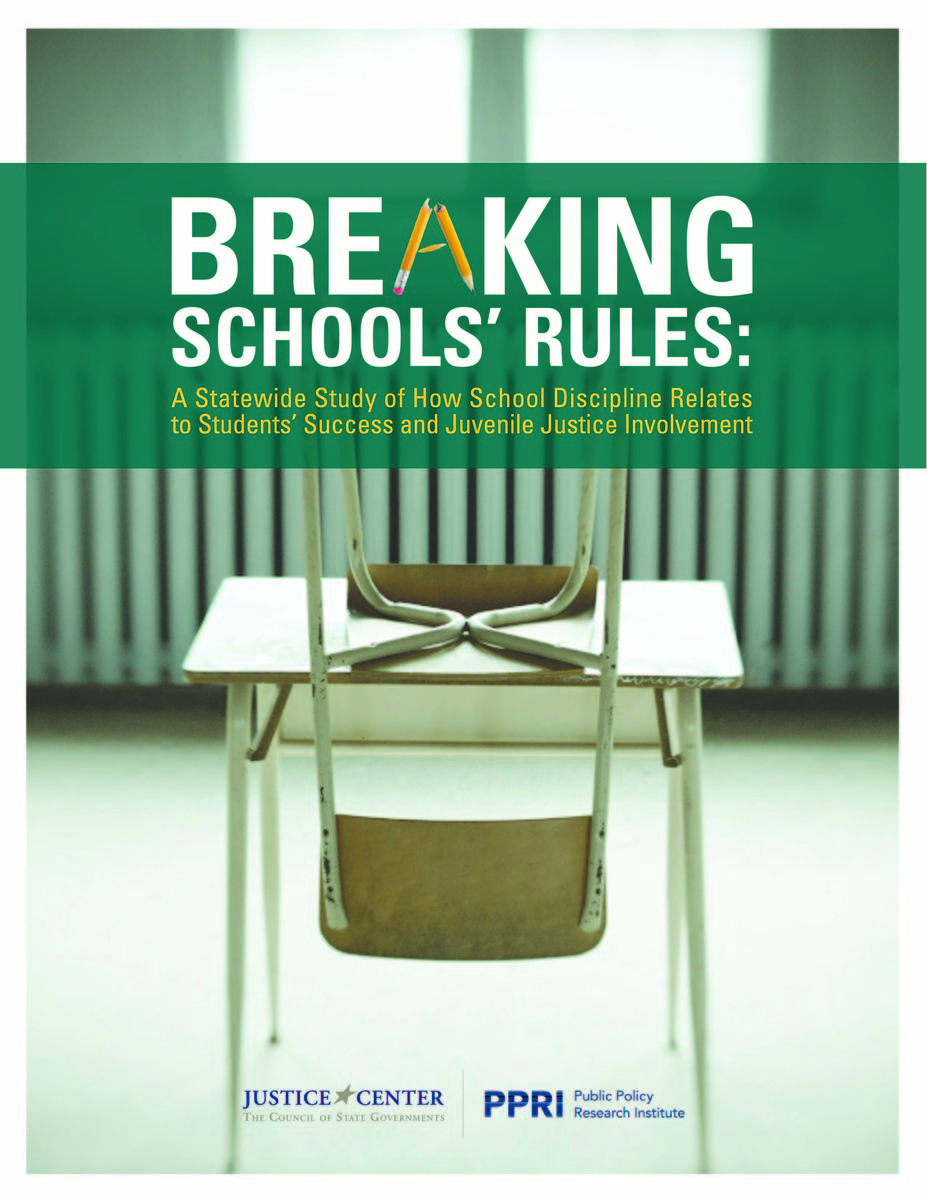
The Council of State Governments Justice Center has just released a report called Breaking Schools' Rules which "describes the results of an extraordinary analysis of millions of school and juvenile justice records in Texas. It was conducted to improve policymakers’ understanding of who is suspended and expelled from public secondary schools, and the impact of those removals on students’ academic performance and juvenile justice system involvement."

"Like other states, school suspensions—and, to a lesser degree, expulsions—have become relatively common in Texas. For this reason and because Texas has the second largest public school system in the nation (where nonwhite children make up nearly two-thirds of the student population), this study’s findings have significance for—and relevance to—states across the country."

The study found that of nearly 1 million Texas public secondary school students followed for more than six years, nearly 60 percent were suspended or expelled.

Key findings in the report include the following:

1. Nearly six in ten public school students studied were suspended or expelled at least once between their seventh- and twelfth-grade school years.

2. African-American students and those with particular educational disabilities were disproportionately likely to be removed from the classroom for disciplinary reasons.

3. Students who were suspended and/or expelled, particularly those who were repeatedly disciplined, were more likely to be held back a grade or to drop out than were students not involved in the disciplinary system.

4. When a student was suspended or expelled, his or her likelihood of being involved in the juvenile justice system the subsequent year increased significantly.

5. Suspension and expulsion rates among schools—even those schools with similar student compositions and campus characteristics—varied significantly.


The findings summarized above demonstrate why it is important for policymakers everywhere to examine the school disciplinary systems in their jurisdictions. This will not be without challenges for many states and will likely include significant investments in state-of-the-art information systems. Having quality data available is only the first step. To produce the unprecedented level of analyses found in this report, policymakers will need to follow the example set by Texas leaders across the political spectrum that showed courage and commitment by digging deep into an issue that has received relatively little public scrutiny.

An important take-away from this study is that individual schools within a state, working with the same resources and within the same statutory framework, have the power to affect their school disciplinary rates. In communities across the country, educators, juvenile justice system officials, service providers, students and parents, and advocates are also taking steps to implement innovative approaches that yield different disciplinary results. Nationally, a growing number of advocacy organizations and membership associations are drawing increased attention for their efforts to come up with more effective and fair approaches to school discipline. And a growing body of research is supporting and expanding upon these efforts. An essential next step is to convene experts, policymakers and advocates from education, juvenile justice, health, and child welfare systems to build on the important work of these stakeholders and to begin developing a consensus around approaches that will improve outcomes for students and teachers.


Why is this important to us? Because of all of the countries in the world, the United States has more people per capita in prison. Of the states, Georgia has one of the highest levels per capita behind bars at 1,021 per 100,000. In fact, according to the New York Times, "the United States has less than 5 percent of the world's population. But it has almost a quarter of the world's prisoners". We need to focus on issues of poverty and ignorance in order to stop this downward spiral. The issue is the worst for African-American males.

The government is building prisons based on third grade reading test scores. They can conclude whether or not a child will go to prison and some point if their literacy score is low. Recent national data from a study of beginning kindergartners show conclusively that African American males start school already behind other groups of children with respect to emergent reading and mathematical skills (ECLS-K, 1998). Thus, problems in elementary school may have roots in the preschool years. Most African American Children are behind on reading but excel in other subjects (Jencks & Phillips, 1998). The gaps don't stop in elementary school, but are evident in middle and high school if never caught up by the early elementary years (Gordon 2-4)

Sadly, the U.S. is far more committed to prisons than to schools. According to this report from Fox News, state governments spend nearly four times more per capita on imprisoning people than on education.

Prison is not the answer in so many cases. Education is the key to freedom and enlightenment. We must do whatever it takes to directly reach each and every student, ensuring them the ability to take care of themselves and their families if we are to enjoy a safe, productive society in the future.

===
http://knowledgecenter.csg.org/drupal/content/breaking-schools-rules-statewide-study

Friday, February 5, 2010

It Takes a Village

by Shayna Steinfeld
(previously published in the The Atlanta Lawyer)

In this issue we celebrate lawyers whose practice concentrates on representing defendants in the criminal justice system. I’ve known many of these lawyers throughout my career and some of them have been my personal everyday heroes. Some of them have been recently honored by the Atlanta Bar and other organizations.

My primary interest this month, however, is in focusing on the correlation between the high school dropout rate and the crime rate. High school dropouts become tomorrow’s criminals, who then need our representation. Today’s at risk students need your current skills so that they won’t need your representation in Court down the road – either as a juvenile or as an adult. Atlanta Magazine, on page 44 of the September 2008 issue, reported that:

Dropouts from Georgia’s class of 2007 will cost the state more than $15.4 billion in lost wages, taxes, and productivity over their lifetimes, according to the Alliance for Excellent Education, a national policy and advocacy group based in Washington, D.C. The Alliance estimates that increasing the graduation rate and college registration rate of male students in Georgia by just 5 percent could lead to a savings and revenue of nearly $276 million each year by reducing crime-related costs (dropouts are eight times as likely to be incarcerated). And raising the graduation rates of Hispanic, African American, and Native American students to the level of whites by 2020 could increase their personal income and add more than $7.9 billion to the state economy. Keeping students in school lowers crime rates, provides skilled employees, improves the economy, raises the value of your property, and most importantly gives kids a chance at a better life.
The dropout rate in Georgia is appalling. According to information I received in a training session from the Georgia Partnership for Excellence in Education in an Education Policy Primer (2008-09 Edition), created by the Georgia Partnership for Excellence in Education in cooperation with the Georgia School Boards Association, In 2004, The United States graduated 74.3% of its public school children and Georgia graduated 61.2% of its children (only South Carolina was lower). Different statistics show DeKalb County’s 2008 high school graduation rate at either 75% or 70%. There is a lot of room for improvement.

Emmet Bondurant has researched and written a thorough paper on the correlation between quality, early pre-k for at-risk children and success throughout the school years and has argued for our legislature to reconsider its priorities in the use of lottery funds vis á vis a greater emphasis on expanding and improving Georgia’s pre-k program. For instance, there are many large counties whose school systems do not have pre-k (e.g. Cobb and Gwinnett) and counties like DeKalb are not fully serving their 4 year olds who could use pre-k. There are other studies that support the correlation between pre-k and higher high school graduation rates – one in Pennsylvania directly related high quality pre-k to reduced later crime rates and one from Dalton, Georgia linked the two. Emmet has been in contact with the Governor’s office, seeking a higher budget priority on pre-k funding, for it to serve all 4 year olds (it now serves only 57% of them) as well as expanding pre-k to 3 year olds.

Emmet has shared statistics with me. The State’s lottery reserves have steadily increased over the past four years. The State now has $946,516,199 estimated in the lottery reserves for fiscal year 2008 (compared to $559,365,024 for fiscal year 2004). Of these funds, $650 million are unrestricted reserves that must be spent, pursuant to the State’s constitution, on HOPE, pre-K, teacher training and educational capital improvements. In the meantime, the Governor has cut over $1.6 billion from the budget for other education programs (for instance after DeKalb County was required by law to pass its budget, it was then required by the Governor to eliminate another $10 million from it, it appears that teachers will not be given a cost of living increase and the state-wide teacher training budget is fixed, in hard dollars, at what it was approximately 20 years ago). An argument can be made that it is immoral and fiscally irresponsible for our government to sit on nearly a billion dollars in Lottery proceeds earmarked for education by our Constitution, when they could be invested in our at risk children. We need to reconsider how we are doing things as a State, ranked in the bottom few nationally in education, and revamp our priorities. Emmet is one of the most well respected lawyers in town and perhaps we should work together to accomplish something this legislative session, as independent lawyers, to reveal the link between high quality pre-k and the reduction of high school dropout rates. Ultimately, then, we also reduce crime rates, reduce the number of individuals on welfare and increase tax revenue. Not to mention plenty of other benefits to society along the way.

A few of the more interesting programs involving Atlanta’s lawyers that have sought to tackle the abysmal high school dropout rates and education have been Terry Walsh’s renowned Truancy Intervention Project (his big project as Atlanta Bar president); Kilpratick Stockton’s adoption of Washington High School following the “Freedom Writers” program, honored by the ADL last spring, the Georgia Appleseed project and “Everybody Wins”. In these efforts, lawyers work with at risk children to keep them in school and work to actively involve parents in their children’s education. We’d love to compile a list of what you, as a Firm, or what your lawyers within your Firm, are specifically doing to assist at risk children in our Atlanta community – please let us know.

I have a vision that follows the line of what Kilpatrick has done. I believe that the ADL will help me (a birdie told me so). Will you? There are 21 high schools in DeKalb County, 1 in the City of Decatur, 9 in Atlanta City Schools and 15 in Fulton County (46 total). There are a number of law firms, accounting firms, real estate firms, consulting firms, corporations, Universities, Associations, and other entities. If 45 entities were to follow Kilpatrick’s example and adopt one high school each, then students who are most at risk could have a mentor and a role model they would know is watching over their shoulder and who would check in on them on a regular basis. They would know that there was someone who cared about their academic progress and who would care if they dropped out. There would be someone to guide them towards college or a vocational program and a successful life after high school. Perhaps we could then also work alongside the other programs that are already in place to bring all of these resources together in a coordinated, city-wide effort to help all of these students succeed.

I say it takes a village because I see it in my own family. My children know that if they make a mistake, I have eyes behind my head. There are a number of adults who care and will let me know what happened. I will not be mad at the messenger for the message. Some parents blame the messenger and this is not productive. In times past, everyone knew everyone and helped each other raise their children. Justin had a much more in depth conversation with a friend of mine over his SAT than the grunts he shared with his dad and me once it was over – he was more comfortable this way. That’s part of the village too. When Judge Hatchett reported her story at the fabulous October 2nd Celebrating Service lunch, she shared her village at her church surrounding the Black Baptist Mothers watching over her and the other children in the projects behind Clark Atlanta and the one in particular who wished her success as she left for Mount Holyoke. She knew with absolute certainty that they cared about her success.

The village seems to be missing in many communities today. If we don’t address the dropout rate in some concrete way as a community, I shudder to think what we’re going to look like down the road. If each of 45 firms and Atlanta’s business and educational community adopts one high school we can do our part to be everyday heroes to our most vulnerable members of society. In doing so, we will make Atlanta and America better for our own children and grandchildren.